Unlike optical filters, severe specifications and performances are generally required
for astronomical IR filters. Very wide blocking range, often from 0.4μm to 2.8μm
(sometimes ~ 5.6μm) is necessary, because HgCdTe detector is sensitive across
a wide range of wavelengths.
Using in vacuum and cryogenic environment also requires IR filters to be made of
a monolithic substrate to avoid abrasion of epoxy glue by thermal shock.
Eventually many and thick layers of interference films are necessary to be coated
on both surfaces of substrate.
We produced "K+L" filter for the NIRSPEC at W. M. Keck Observatory in 2026.
Unprecedentedly and extremely broad passband (over 2μm!) and wide blocking
range were achieved on fragile CaF2 substrate thanks to our proprietary magnetron
sputtering technology.
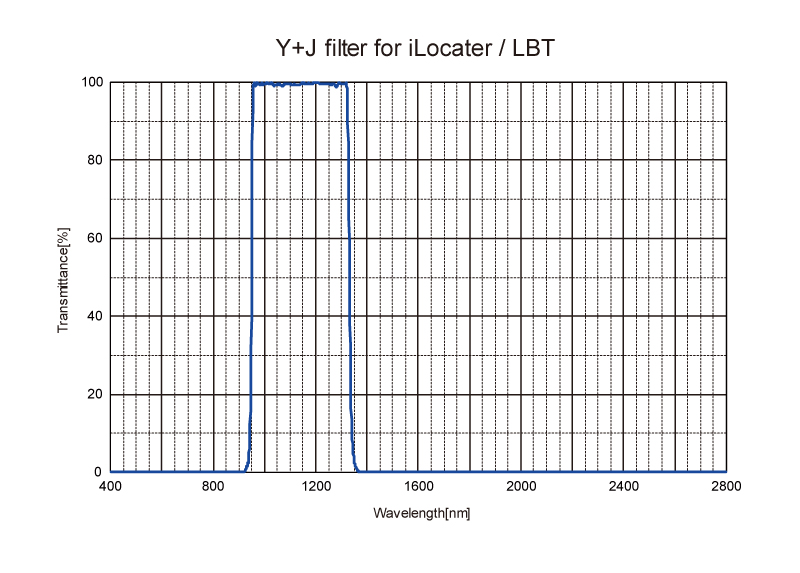
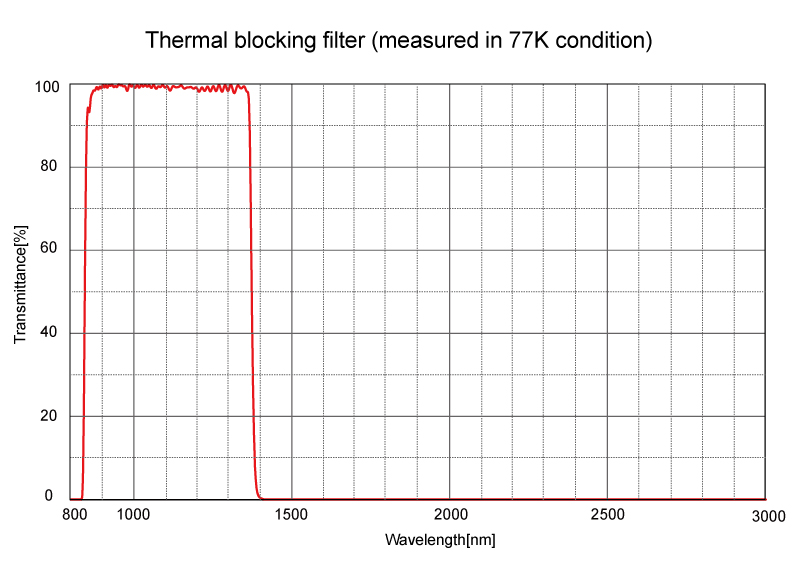
Recently, thermal blocking filter is often asked as well as Mauna Kea Observatories Y, J, H, Ks filters.
We provided the thermal blocking filters to Dunlap Institute for Astronomy and Astrophysics in Canada.
They were coated by the state-of-the-art magnetron sputtering technology on the monolithic fused silica substrate, and had
high transmission passband and excellent blocking performance in IR (i.e. thermal) wavelengths.
Actual transmission was also measured and evaluated in 77K cryogenic condition by using the witness sample at Asahi factory.